

Key Takeaways:
ChatGPT just rolled out a new Shopping Research feature. It behaves like a personal shopper that remembers your preferences, compares products for you, and explains why it is recommending each item.
For brands in Australia, this is not a fun gimmick. This is a new discovery layer that sits between your customers and your website.
Your product data, your schema, your reviews, your content structure, and your LLM visibility decide whether you show up here.
AI has been poking around the edges of e-commerce for a while, but ChatGPT’s latest shopping update pushes it straight into the trolley. This is not a “fun little recommendation widget.” This is a full end-to-end shopping assistant that asks you what yoghurt you prefer, compares 15 products, and builds a shortlist faster than you can say “half-price at Coles.”
If you read our recent breakdown on ChatGPT Shopping and how LLMs are rewriting ecommerce, you already know what’s coming. And if you saw our LLM referral traffic analysis, you know brands are already getting traffic from AI engines, whether they’re ready or not.
This feature shows the future in action, and Australian brands need to take it seriously.
Below, you’ll see what ChatGPT Shopping actually does. Then we’ll talk about the data, product structure and site experience you’ll need so your brand is not invisible inside these assistant journeys.
1. It Doesn’t ‘Search’. It Interviews You
Start with a simple question like “Best yoghurt brand in Australia.” ChatGPT immediately does what humans do.
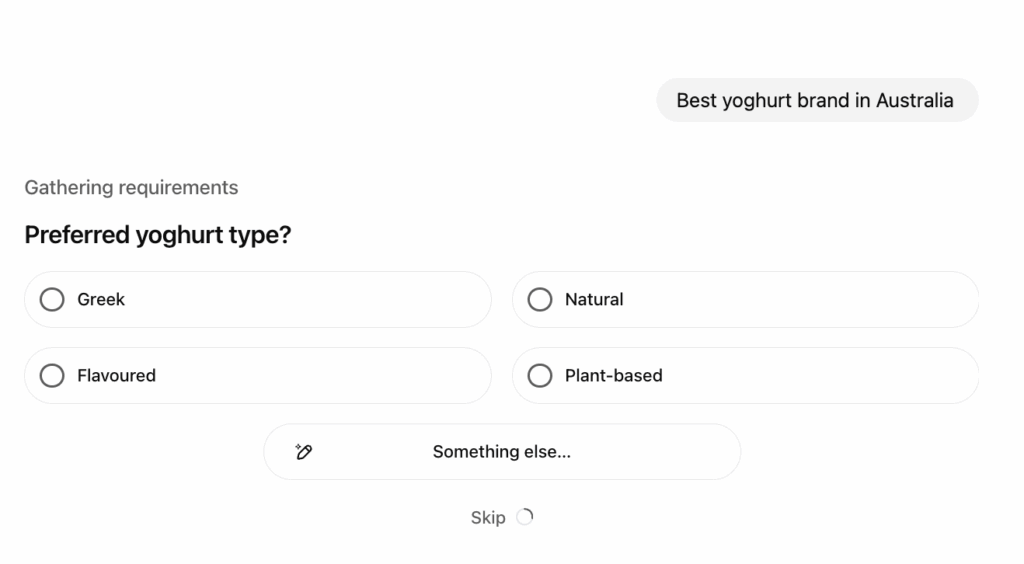
ChatGPT starts by interrogating the shopper. Not in a scary way. In a “tell me who you are so I don’t waste your time” way.
It collects:
- Preferences
- Budget
- Dietary needs
- Features you care about
- Features you hate
This is the first major shift.
Search used to rely on keywords. LLM shopping relies on context + intention + constraints.
2. It Adjusts Search Based on Every Answer
This behaviour is huge. ChatGPT isn’t retrieving products based on a single query. It is iterating its understanding of the user with every choice.
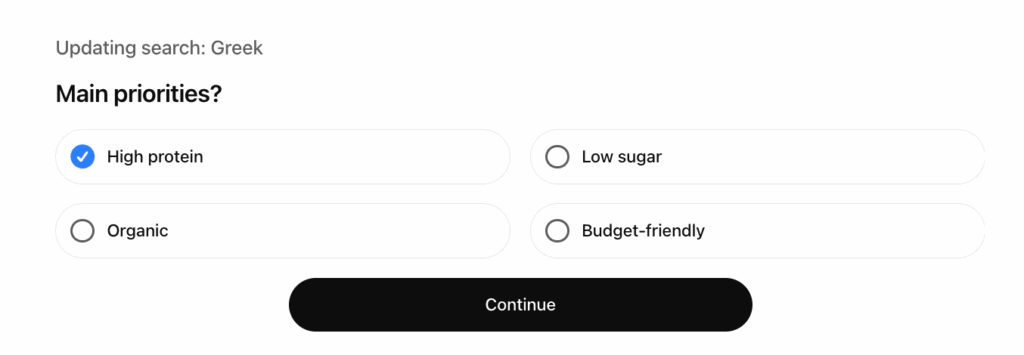
This means your descriptors matter.
- Your schema matters.
- Your feature data matters.
- Your reviews matter.
It is basically saying: If your product data is vague, your product is invisible.
3. Real Products, Real Prices, Real Retailers
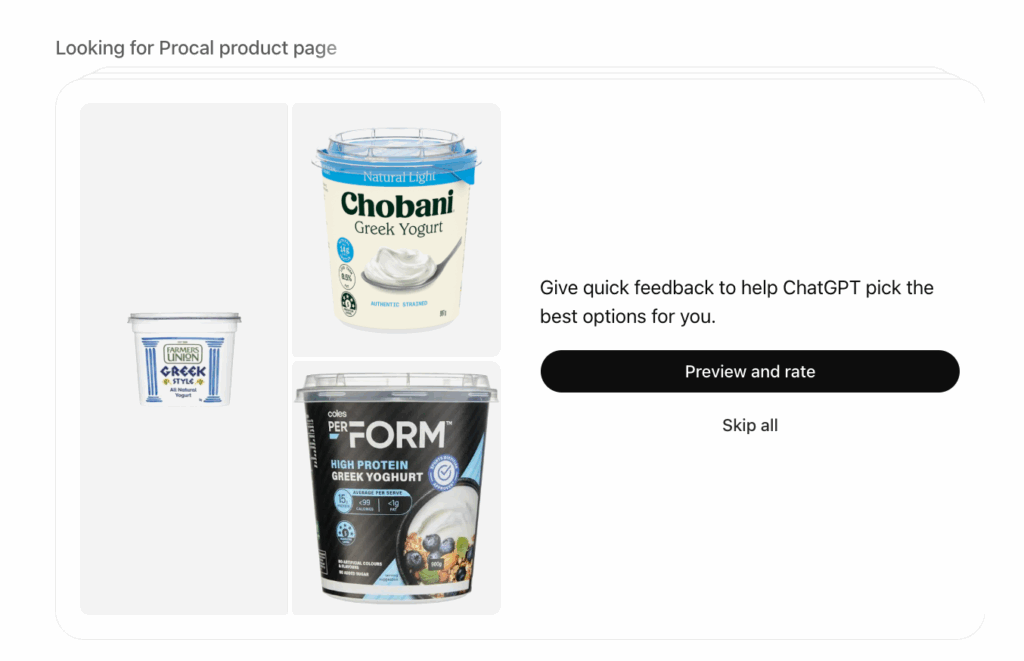
ChatGPT pulls live retailer data. It treats your product like a datapoint. It doesn’t care how big you are. If you want a seat at this table, you need:
- Lean product feeds
- Consistent GTINs
- Structured data
- Matching titles across platforms
- Retailer coverage
This is not optional. This is the new baseline.
4. It Looks at Your Product Page Like a Human Would

ChatGPT checks:
- Price
- Reviews
- Ingredients
- Benefits
- Packaging size
- Retailer reliability
This is no longer just a SERP game. Your product detail pages become your ranking signals. If your PDPs are thin, inconsistent, duplicated, messy, or using vague feature lists, you are handing your visibility to competitors who clean their data better.
5. Asks Why You Don’t Like a Product
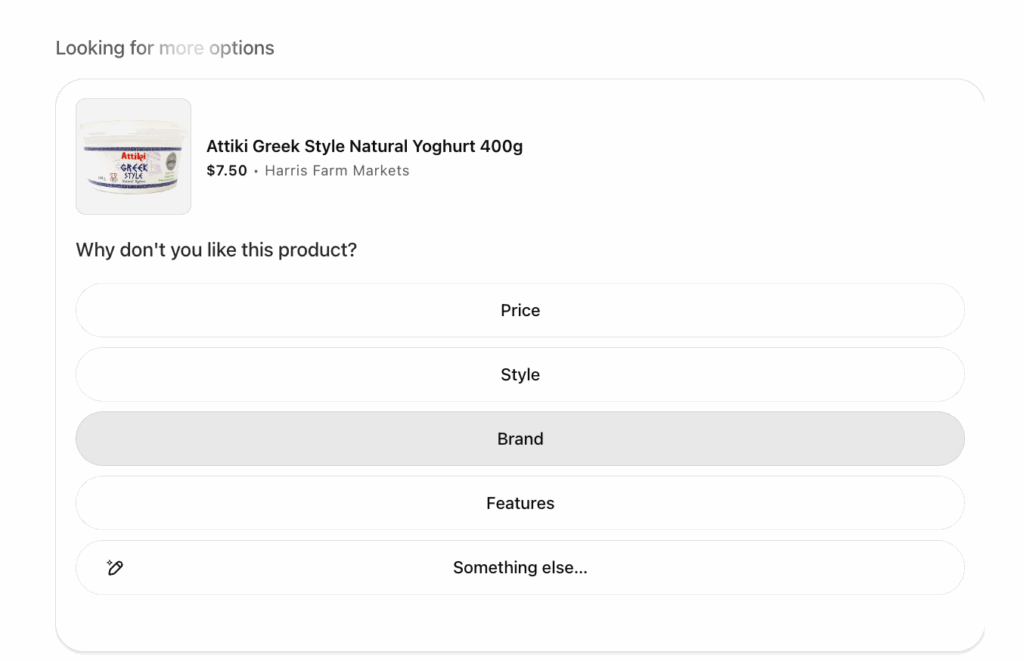
This is the killer feature.
ChatGPT learns why users don’t choose you from real-time behavioural feedback, not from surveys or from guesswork.
If someone says “price”, “brand”, “style”, “features”, that becomes a visible input for the ranking logic.
This will reshape:
- Product positioning
- Value messaging
- Competitor analysis
- Content strategy
- CRO testing
- PDP hierarchy
This is LLM-powered consumer research hiding in plain sight.
6. Produces a Full Buying Guide
This is the part that hits e-commerce teams the hardest.
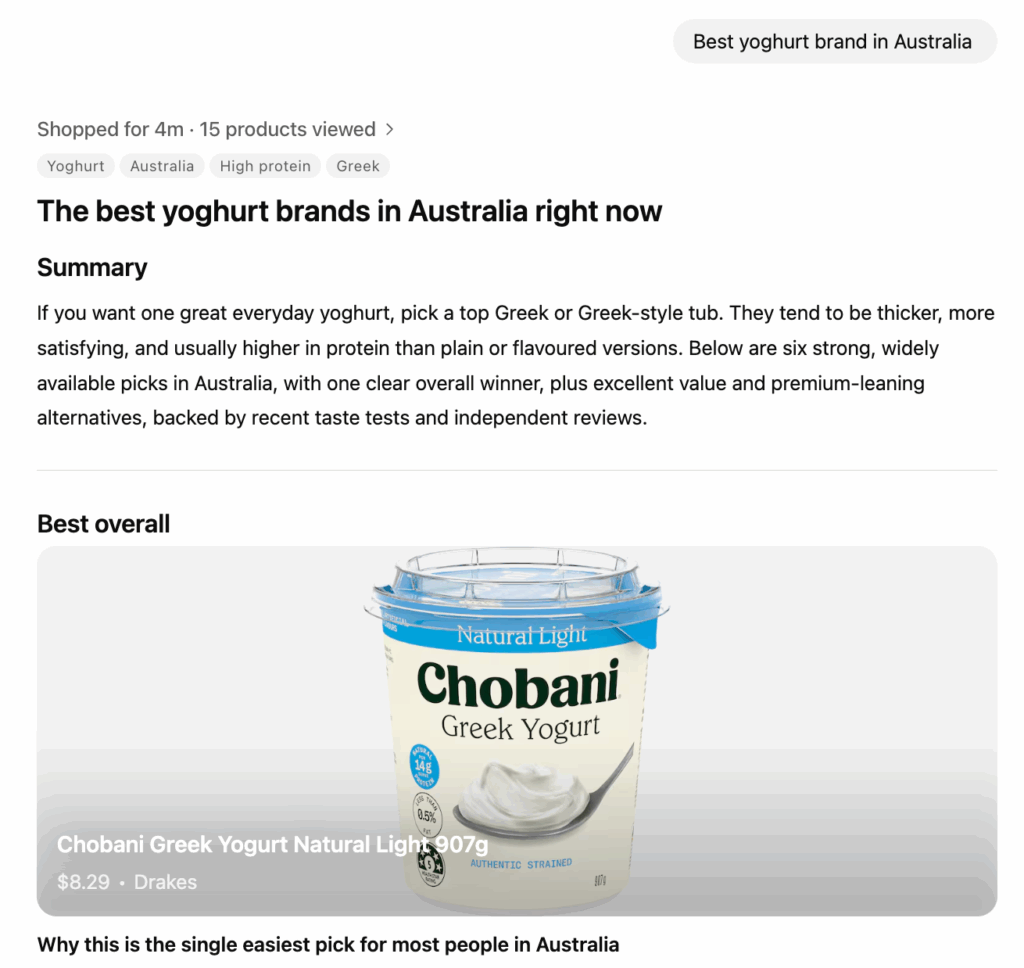
ChatGPT builds a buying guide that looks like Choice, Wirecutter, or CHOICE Australia. Except it is personalised to the shopper. It ranks. It compares. It summarises. It justifies. It offers tradeoffs. It offers alternatives.
This means your brand is now competing inside a curated expert-style report generated on demand
7. And Yes, It Compares Everything Side by Side
This is where the quality of data becomes the deciding factor.
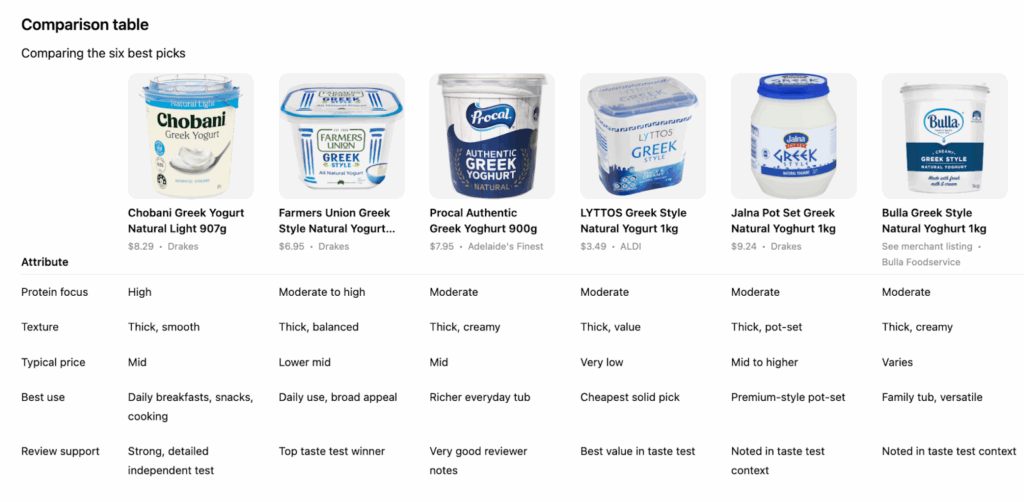
- If your product data is incomplete, generic, or inconsistent, the AI cannot place you.
- If it cannot place you, it cannot recommend you.
- If it cannot recommend you, you lose the sale before the shopper even hits your site.
8. It Even Tells Shoppers How To Decide
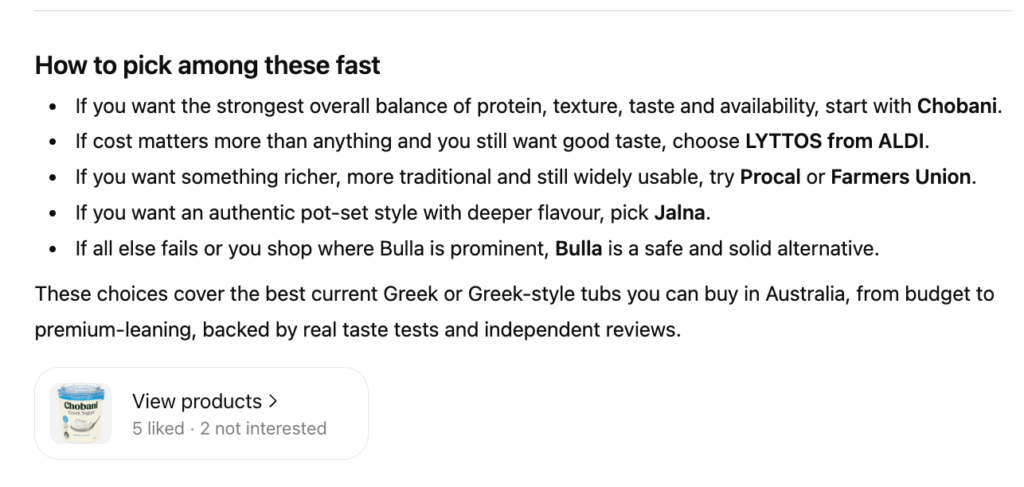
It gives rules of thumb like:
- “Pick Chobani if you want balance”
- “Pick Lyttos if price is key”
- “Pick Procal or Farmers Union if you want something richer”
- “Pick Jalna for pot-set”
In other words, the AI becomes your category’s spokesperson. If your brand positioning is clear, consistent, and well-structured across all platforms, the AI can articulate it. If not, it can’t.
So What Should Australian Brands Do Next?
Here’s the honest checklist.
- Clean your product data
- Fix titles
- Fix variants
- Fix feeds
- Fix schema
- Fix mismatches across retailers
- Strengthen your PDPs
- More clarity
- More attributes
- More structured content
- More trust signals
- Build LLM-ready content
To make your content LLM ready, inlude:
- FAQs
- Comparisons
- Ingredients
- Benefits
- Use case studies
- Track your LLM visibility
You already saw this in our blog ‘What Your LLM Referral Traffic Is Trying To Tell You’. This is the moment to start measuring it.
- Prepare your team
The shift is fast. Your content, SEO, CRO, paid, and retail teams need shared language and shared data.
Ready to Upgrade Your Store for the LLM Era?
At Yoghurt Digital we help brands across Australia get ahead of AI-led commerce.
If you want your products to show up in the next wave of Shopping Research, we can help you clean your data, structure your PDPs, build LLM-ready content, and measure your visibility.Talk to Us. Let’s build the store your future customers already expect.